Victor Vasarely was born on April 9, 1906, in the city of Pécs, Hungary. From an early age, he showed a strong inclination toward painting, and his first known work—a pastoral landscape—dates back to 1918, when he was twelve years old. After graduating from high school, he began studying medicine at the University of Budapest, but he soon abandoned it in order to devote himself entirely to art.
In 1927 he enrolled at the private Podolini-Volkmann Academy, where he received his first formal training in painting and began to systematically develop his talent. Two years later, he transferred to the school of Alexander Bortnyik, who was recognized as a pioneer of Hungarian art influenced by international movements and a representative of Bauhaus in Budapest. The school, called “Mühely” (“Workshop”), was based on the principles of the Bauhaus school in Weimar. The lessons, held at Bortnyik’s home, combined theory and practice in architecture and painting, with a focus on graphic arts and typography. There, Vasarely was introduced to the principles of abstract design and began moving away from objective representation, as seen in works such as Blue Study (1930) and Green Study (1929) from that period.
In 1930 Vasarely moved to Paris, where he worked as a designer for advertising agencies, while remaining somewhat distant from the artistic movements of the time. His involvement in advertising occupied him almost entirely during his first ten years in Paris. At the same time, he was developing the idea of founding a school modeled on the Bauhaus in Paris, adapting some of his works for teaching purposes. For two years, from 1942 to 1944, he lived outside Paris in isolation, a period during which he focused on graphic studies and modern painting, especially the works of Paul Klee, Antoine Pevsner, and Sophie Taeuber-Arp.
In 1944, a general exhibition of his paintings, graphic works, and advertisements was held at the opening of Denise René’s gallery. In the following years, he refined his technique, moving from figurative art toward more abstract forms. In 1955 he initiated a group exhibition titled Le Mouvement (“The Movement”) and published the “Yellow Manifesto,” in which he presented his ideas. The exhibition focused on kinetic art and included artists such as Marcel Duchamp and Alexander Calder. Through this event, Vasarely became established as one of the pioneers of Op Art and a leading figure in postwar avant-garde art in Paris, leading to awards, honors, and participation in major exhibitions. In 1964 he received the Guggenheim Prize in New York, and his works gained major recognition in the exhibition “Lumière et Mouvement” (“Light and Movement”) at the Museum of Modern Art in Paris in 1967. In 1970 he was made a Knight of the Legion of Honour, and six years later the Vasarely Foundation was inaugurated, designed and funded by him, along with the Vasarely Museum in his birthplace, Pécs. In 1987 another Vasarely Museum opened in the Zichy Palace in Budapest.
Vasarely died on March 15, 1997, at the age of 91, in Paris.
Work
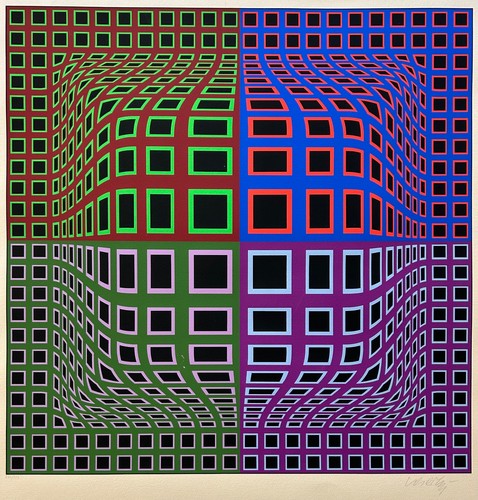
Vasarely was one of the most famous artists of the postwar period, especially in the 1960s and 1970s. His work is characterized by his belief in the social function of art and his desire to integrate artistic creation into everyday life. He developed an approach based on the viewer’s direct visual perception, regardless of artistic background or education. He often argued that the art of the future should be the product of planning and mass production, based on the “plastic alphabet” he invented in the 1950s.
Graphic studies and the Belle-Isle period
His early works (1929–1944), during his first stay in Paris, consist of graphic studies in which he experimented with optical effects, exploring artistic problems related to color, materials, and spatial dimensions. Works from this period include grids and patterns such as zebras, tigers, and checkerboards, with notable examples being The Chessboard (1935) and Study M.C. (1936).
After World War II, he moved to a studio in the suburb of Arcueil. For three years he completed several oil paintings, such as The Yellow Kitchen at Cocherel (1946) and Self-Portrait (1942), influenced by Futurism, Cubism, and Surrealism. He later considered these works a “wrong path” and gradually turned toward Constructivism, developing his own geometric abstraction. In the summer of 1947 he spent time in the coastal town of Belle-Île in Brittany, an important turning point in his development. This period (1947–1958), known as the Belle-Île phase, marked his shift toward abstraction. The years 1951–1958 are also referred to as the Denfert period, named after the Paris Métro station Denfert-Rochereau.
During this time he adopted smooth color surfaces instead of visible brushwork. One of his most significant works from this period is Homage to Malevich, created in several versions between 1952 and 1958, marking his move toward kinetic art.
Kinetic art
Vasarely’s work gained new momentum as he sought to represent movement and time on flat surfaces. His paintings were designed to be fully understood only through the viewer’s movement, making the observer an active participant in the artwork. In 1955, he organized the exhibition Le Mouvement at the Denise René gallery, featuring artists such as Marcel Duchamp, Man Ray, and Alexander Calder. Alongside the catalog, he published the Yellow Manifesto, presenting his ideas on kinetic art based on basic geometric elements.
His kinetic works followed the series titled Black–White (1954–1960), characterized by symmetrical black-and-white forms that interact visually. Representative works include Bitlinko (1956), Oet-Oet (1955), and Supernovae (1959–61), which explored binary visual systems.
Plastic alphabet
In the Yellow Manifesto, Vasarely introduced the concept of the “visual unit,” a basic artistic element. Its structure consisted of a square containing a colored geometric shape. Unlike earlier black-and-white dualities, this unit allowed unlimited variation. These structures formed the “plastic alphabet,” which he presented in 1963 at the exhibition Planetary Folklore at the Museum of Decorative Arts in Paris. He patented this invention in 1957.
Based on this system, he also created three-dimensional works called “BIDIM,” often colorful wooden or metal compositions. In the early 1970s, he founded the Vasarely Foundation in Aix-en-Provence, designing its building and installing large-scale works, aiming to realize his architectural and artistic vision.